Klotho
Klotho Peptide Fragment
Makoto Kuro-o discovered the Klotho gene in 1997 by accident. He mutated a gene in mice, watched them suffer catastrophic premature aging, and named the missing protein after the Greek fate who spins the thread of life. Today, researchers use recombinant soluble alpha-Klotho to study age reversal. You are not dealing with a simple five-amino-acid chain here—this is a massive, complex protein that dictates how gracefully cells handle oxidative stress.
Purity
99%+
Molecular Weight
130 kDa
Administration
Subcutaneous injection or intravenous infusion
Storage
Store lyophilized powder at -20°C
Mechanism of Action
Klotho pulls double duty in human physiology. In the kidneys, it acts as a mandatory co-receptor for FGF23 to strictly regulate phosphate and vitamin D metabolism. The soluble, circulating form acts as a powerful endocrine hormone that suppresses insulin/IGF-1 signaling, effectively mimicking the longevity benefits of caloric restriction. It also slams the brakes on Wnt signaling, which prevents stem cell exhaustion and stops tissues from turning fibrotic as we age.
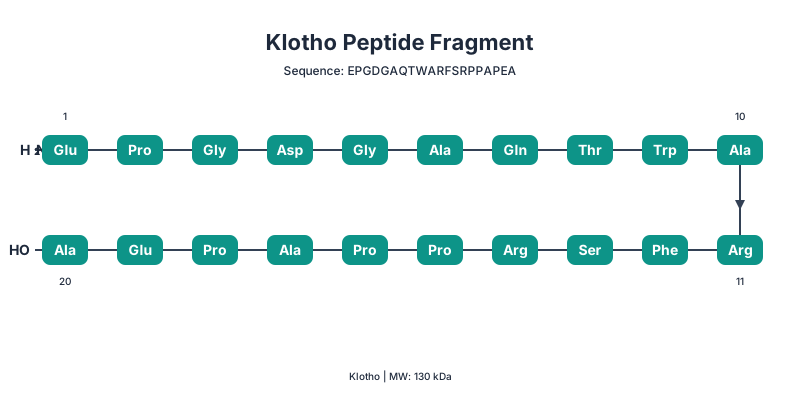
Sequence:
EPGDGAQTWARFSRPPAPEA (Partial N-terminal extracellular domain of 1012-amino-acid recombinant protein) Chemical Structure
Research Areas
- Cognitive decline and spatial memory enhancement
- Chronic kidney disease (CKD) progression
- Vascular calcification and endothelial health
- Muscle stem cell (satellite cell) preservation
- Systemic lifespan extension in mammalian models
Potential Benefits
- Reverses age-related cognitive deficits
- Prevents arterial stiffening and calcification
- Protects against renal fibrosis
- Maintains muscle regeneration capacity in older subjects
- Drives systemic lifespan extension
Research Dosing Guidelines
For research purposes only. Not for human consumption.
Typical Dose
1-2 mg
Frequency
1-2 times per week
Duration
4-8 weeks
Administration
Subcutaneous injection or intravenous infusion
Let's be blunt: recombinant human Klotho is massive and highly fragile. Do not shake the reconstituted vial. Most longevity researchers cycle this alongside NAD+ precursors. Because of its molecular weight, systemic absorption via SubQ is significantly slower than small peptides, which is why clinical research clinics lean heavily toward IV administration.
Reconstitution Calculator
U-100 Insulin Syringe
0.0 units
2500 mcg/ml
0.0004 ml
0.0 IU
5000
For research and educational purposes only. Always follow proper reconstitution and sterile handling protocols.
Klotho and the Hallmarks of Aging
Klotho intersects with multiple hallmarks of aging simultaneously, which is what makes it such a compelling target for longevity research.
Klotho vs Aging Hallmarks
| Hallmark of Aging | Klotho's Effect | Evidence |
|---|---|---|
| Cellular senescence | Suppresses Wnt signaling to prevent stem cell exhaustion | Strong (animal) |
| Mitochondrial dysfunction | Reduces oxidative stress via insulin/IGF-1 suppression | Moderate (animal) |
| Genomic instability | Protects DNA from oxidative damage | Moderate (in-vitro) |
| Deregulated nutrient sensing | Mimics caloric restriction pathways | Strong (animal) |
| Loss of proteostasis | Indirect support through reduced oxidative load | Limited |
| Altered intercellular communication | Acts as endocrine hormone regulating multiple organs | Strong (animal) |
No other single protein addresses as many aging hallmarks simultaneously as Klotho, which explains why its deficiency causes such rapid, multi-organ aging in animal models.
Potential Side Effects
- Altered phosphate and calcium metabolism
- Unknown long-term endocrine effects in humans
- Temporary fatigue post-administration
- Injection site erythema
Storage Requirements
Store lyophilized powder at -20°C. Once reconstituted, keep at 2-8°C and use within 7 days.
Research References
- [1]Mutation of the mouse klotho gene leads to a syndrome resembling ageing (1997)Emerging Evidence Population: Klotho gene knockout mice
Defects in gene expression yielded mice with severe premature aging phenotypes, establishing Klotho's role in lifespan regulation.
Limitations: Complete gene knockout; partial supplementation effects may differ from total deficiency
- [2]Life extension factor klotho enhances cognition (2014)Emerging Evidence Population: Young and aged transgenic mice with Klotho overexpression
Elevating Klotho expression improved learning and spatial memory while increasing synaptic plasticity in the hippocampus.
Limitations: Genetic overexpression model; exogenous protein delivery may produce different results
- [3]Klotho and aging (2009)Preclinical Population: Review of Klotho biology across mammalian models
Soluble Klotho acts as an endocrine factor that suppresses oxidative stress and regulates multiple aging-associated signaling pathways.
Limitations: Narrative review; no direct interventional human data available
Frequently Asked Questions
What is Klotho?
Klotho is a massive anti-aging protein originally discovered in 1997. In research settings, it is typically used in its soluble, recombinant alpha-Klotho form to study age reversal and tissue protection. Mice lacking this protein age rapidly, while those overexpressing it live significantly longer.
What are the potential research benefits of Klotho?
Animal studies show Klotho can reverse age-related cognitive decline, prevent arterial stiffening, and protect against kidney fibrosis. It also preserves muscle stem cell function, allowing older tissue to regenerate like younger tissue.
How is Klotho typically dosed in research?
Researchers typically administer 1-2 mg of recombinant Klotho via subcutaneous injection or IV infusion, one to two times per week. Cycles generally run 4-8 weeks, though stability and absorption remain serious hurdles due to the protein's massive size.
What are the side effects of Klotho?
Because Klotho strictly regulates mineral metabolism in the kidneys, the primary risks involve altering calcium and phosphate balance in the body. Other reported issues include injection site reactions and temporary fatigue, and human safety data remains extremely sparse.
How should Klotho be stored?
Lyophilized Klotho must be stored at -20°C. Once reconstituted, keep it perfectly still at 2-8°C and use it within 7 days to prevent the fragile protein structure from degrading.
Ready to Purchase Klotho?
Get the highest quality Klotho from our recommended vendor with 99%+ purity guaranteed.
Buy at Simple PeptideRelated Topics
Biological Roles of Peptides in Humans
Peptides serve as crucial signaling molecules in the human body, functioning as hormones, neurotransmitters, and immunomodulators that regulate virtually every physiological process.
Therapeutic Applications of Peptides
Therapeutic peptides occupy the pharmacological space between small molecules and biologics, offering high selectivity for protein-protein interactions with lower immunogenicity.
Safety & Reference
Related Peptides
Epithalon
Epithalon (Epitalon)
Epithalon is a synthetic tetrapeptide based on the natural peptide epithalamin, which is produced by the pineal gland. It has been extensively researched for its ability to activate telomerase and potentially extend lifespan in animal models.
Learn MoreFOXO4-DRI
FOXO4-D-Retro-Inverso Peptide
FOXO4-DRI isn't a tissue-builder—it's a targeted assassin for senescent cells. Developed by Peter de Keizer's team at Erasmus University in 2017, this peptide is engineered to hunt down the "zombie cells" that refuse to die and instead pump inflammatory garbage into your tissues. The "DRI" stands for D-Retro-Inverso, meaning researchers flipped the sequence backwards and used mirror-image amino acids. This structural hack makes the peptide practically bulletproof against enzymatic breakdown, allowing it to survive long enough to do its job.
Learn MoreHumanin
Humanin (HN)
Humanin isn't your standard synthetic chain. It's a mitochondrial-derived peptide (MDP) encoded directly in the 16S rRNA gene of your mitochondrial DNA. Japanese researchers stumbled on it in 2001 while analyzing surviving neurons in Alzheimer's brains. The fact that mitochondria pump out their own protective peptides to keep host cells alive under extreme stress is fascinating. Let's be real—the human data is still thin, but the rodent longevity and neuroprotection models are aggressive.
Learn MoreMOTS-C
Mitochondrial Open Reading Frame of the Twelve S rRNA-c
MOTS-c isn't your standard synthetic peptide concocted in a lab. It is a naturally occurring mitochondrial-derived peptide (MDP) discovered by USC researchers in 2015. The wild part is that it's encoded directly in the mitochondrial DNA rather than the cellular nucleus. The scientific community unofficially calls it the 'exercise mimetic' because it forces cells into a state of metabolic stress identical to high-intensity cardiovascular training.
Learn More