Humanin
Humanin (HN)
Humanin isn't your standard synthetic chain. It's a mitochondrial-derived peptide (MDP) encoded directly in the 16S rRNA gene of your mitochondrial DNA. Japanese researchers stumbled on it in 2001 while analyzing surviving neurons in Alzheimer's brains. The fact that mitochondria pump out their own protective peptides to keep host cells alive under extreme stress is fascinating. Let's be real—the human data is still thin, but the rodent longevity and neuroprotection models are aggressive.
Purity
99%+
Molecular Weight
2687.2 g/mol
Administration
Subcutaneous injection
Storage
Store lyophilized powder at -20°C for up to 24 months
Mechanism of Action
Humanin works primarily by slamming the brakes on cellular apoptosis (programmed cell death). Inside the cell, it binds directly to the pro-apoptotic protein Bax, preventing it from puncturing the mitochondrial membrane and spilling cytochrome c. On the outside, it hits the FPRL1 receptor and a trimolecular receptor complex (CNTFR/WSX-1/gp130) to kick off JAK2/STAT3 and ERK1/2 signaling. Translation: it stabilizes the cell under heavy metabolic or oxidative stress and forces it to survive conditions that would normally destroy it.
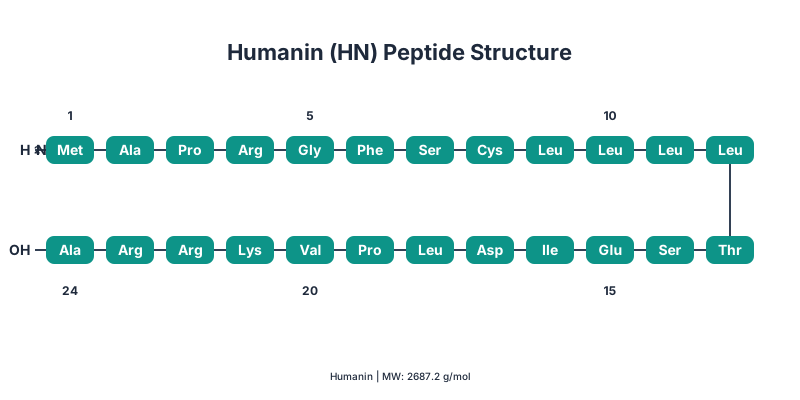
Sequence:
Met-Ala-Pro-Arg-Gly-Phe-Ser-Cys-Leu-Leu-Leu-Leu-Thr-Ser-Glu-Ile-Asp-Leu-Pro-Val-Lys-Arg-Arg-Ala Chemical Structure
Research Areas
- Alzheimer's and neurodegeneration
- Age-related macular degeneration
- Ischemic stroke recovery
- Type 2 diabetes and insulin resistance
- Cardiac ischemia-reperfusion injury
Potential Benefits
- Prevents stress-induced cellular apoptosis
- Protects neurons from amyloid-beta toxicity
- Improves systemic insulin sensitivity
- Reduces oxidative damage in cardiac tissue
- Preserves mitochondrial structure under metabolic load
Research Dosing Guidelines
For research purposes only. Not for human consumption.
Typical Dose
2-5 mg
Frequency
2-3 times per week
Duration
4-6 weeks
Administration
Subcutaneous injection
This is deeply experimental territory, with most protocols scaled up from rodent studies. Biohackers usually stack this with other mitochondrial peptides like MOTS-c. Keep cycles short given the heavy anti-apoptotic mechanism—forcing cells to survive isn't something you want running unregulated year-round.
Reconstitution Calculator
U-100 Insulin Syringe
0.1 units
2500 mcg/ml
0.0008 ml
0.1 IU
2500
For research and educational purposes only. Always follow proper reconstitution and sterile handling protocols.
Mitochondrial-Derived Peptides: Humanin, MOTS-c, and SS-31
Humanin belongs to the family of mitochondrial-derived peptides (MDPs) — signaling molecules encoded directly in mitochondrial DNA. Here's how the three major MDPs compare.
MDP Comparison
| Factor | Humanin | MOTS-c | SS-31 (Elamipretide) |
|---|---|---|---|
| Primary action | Anti-apoptotic (cell survival) | Metabolic activator (AMPK) | Cardiolipin stabilization |
| Best for | Neuroprotection, cell rescue | Fat loss, exercise mimicry | Mitochondrial repair, aging |
| Encoded in | 16S rRNA gene (mtDNA) | 12S rRNA gene (mtDNA) | Synthetic (not encoded) |
| Key pathway | Bax inhibition, STAT3 | AMPK, folate cycle | Cardiolipin-cytochrome c |
| Human data | Minimal | Minimal | Phase II/III trials |
| Primary risk | May protect malignant cells | Hypoglycemia | Injection site pain |
Each MDP addresses a different aspect of mitochondrial aging: Humanin prevents stressed cells from dying, MOTS-c forces metabolic adaptation, and SS-31 physically repairs the energy-producing machinery. Some researchers stack all three for comprehensive mitochondrial support.
Potential Side Effects
- Injection site pain or redness
- Theoretical risk of protecting malignant cells (due to anti-apoptotic nature)
- Unknown long-term endocrine disruptions
- Mild lethargy post-injection
Storage Requirements
Store lyophilized powder at -20°C for up to 24 months. Once reconstituted, store at 2-8°C and use within 14 days. Do not freeze reconstituted peptide.
Research References
- [1]A rescue factor abolishing neuronal cell death by a wide spectrum of familial Alzheimer's disease genes and Abeta (2001)Preclinical Population: Primary cortical neurons treated with familial AD gene products
Identified Humanin as a potent survival factor that protects neurons from Alzheimer's-related toxicity.
Limitations: In-vitro neuronal cultures; neuroprotection may not translate to clinical AD outcomes
- [2]Humanin: a novel central regulator of peripheral insulin action (2009)Emerging Evidence Population: Male Sprague-Dawley rats with intracerebroventricular administration
Demonstrated that central administration of Humanin significantly improves peripheral insulin sensitivity.
Limitations: Central (ICV) administration route; peripheral delivery effects may differ substantially
- [3]Humanin and its analogues: a new hope for disease? (2019)Preclinical Population: Review of preclinical humanin studies across disease models
Detailed the mechanistic pathways by which Humanin prevents apoptosis and mitigates age-related diseases.
Limitations: Narrative review; no controlled human trials referenced
Frequently Asked Questions
What is Humanin?
Humanin is a mitochondrial-derived peptide (MDP) naturally encoded within the 16S rRNA gene of mitochondrial DNA. Discovered in 2001, it acts as a cellular survival factor by preventing programmed cell death under extreme stress. Researchers are heavily investigating its role in longevity and neuroprotection.
What are the potential research benefits of Humanin?
Research shows Humanin aggressively blocks cellular apoptosis and reduces oxidative stress in tissue. Animal models demonstrate specific benefits like protecting neurons from amyloid-beta toxicity, improving insulin sensitivity, and preserving cardiac tissue during ischemic events.
How is Humanin typically dosed in research?
Experimental protocols generally use 2-5 mg administered via subcutaneous injection two to three times per week. Cycles are purposely kept short, usually 4-6 weeks, because long-term manipulation of apoptotic pathways lacks safety data.
What are the side effects of Humanin?
Human data is extremely limited, so most side effects are theoretical or anecdotal. Short-term reports include injection site redness and mild lethargy. The primary concern in research is the theoretical risk of protecting damaged or malignant cells, given the peptide's strong anti-apoptotic nature.
How should Humanin be stored?
Lyophilized Humanin must be stored at -20°C or colder for long-term stability. Once reconstituted with bacteriostatic water, keep it refrigerated at 2-8°C and use within two weeks.
Ready to Purchase Humanin?
Get the highest quality Humanin from our recommended vendor with 99%+ purity guaranteed.
Buy at Simple PeptideRelated Topics
Biological Roles of Peptides in Humans
Peptides serve as crucial signaling molecules in the human body, functioning as hormones, neurotransmitters, and immunomodulators that regulate virtually every physiological process.
Therapeutic Applications of Peptides
Therapeutic peptides occupy the pharmacological space between small molecules and biologics, offering high selectivity for protein-protein interactions with lower immunogenicity.
Safety & Reference
Related Peptides
Epithalon
Epithalon (Epitalon)
Epithalon is a synthetic tetrapeptide based on the natural peptide epithalamin, which is produced by the pineal gland. It has been extensively researched for its ability to activate telomerase and potentially extend lifespan in animal models.
Learn MoreMOTS-C
Mitochondrial Open Reading Frame of the Twelve S rRNA-c
MOTS-c isn't your standard synthetic peptide concocted in a lab. It is a naturally occurring mitochondrial-derived peptide (MDP) discovered by USC researchers in 2015. The wild part is that it's encoded directly in the mitochondrial DNA rather than the cellular nucleus. The scientific community unofficially calls it the 'exercise mimetic' because it forces cells into a state of metabolic stress identical to high-intensity cardiovascular training.
Learn MoreSS-31
Elamipretide (SS-31)
SS-31, clinically known as Elamipretide, forces us to rethink how we handle cellular aging. Discovered by researchers Hazel Szeto and Peter Schiller (hence the 'SS' designation), this tetrapeptide physically localizes to the inner mitochondrial membrane. Most longevity compounds try to boost mitochondrial function indirectly through signaling pathways. SS-31 ignores the middleman and acts as a targeted structural reinforcement exactly where the cell generates energy.
Learn More