FOXO4-DRI
FOXO4-D-Retro-Inverso Peptide
FOXO4-DRI isn't a tissue-builder—it's a targeted assassin for senescent cells. Developed by Peter de Keizer's team at Erasmus University in 2017, this peptide is engineered to hunt down the "zombie cells" that refuse to die and instead pump inflammatory garbage into your tissues. The "DRI" stands for D-Retro-Inverso, meaning researchers flipped the sequence backwards and used mirror-image amino acids. This structural hack makes the peptide practically bulletproof against enzymatic breakdown, allowing it to survive long enough to do its job.
Purity
99%+
Molecular Weight
2273.6 g/mol
Administration
Subcutaneous injection
Storage
Store lyophilized powder at -20°C for up to 2 years
Mechanism of Action
Senescent cells stay alive by using the FOXO4 protein to bind and trap p53, preventing this master tumor suppressor from triggering cell death. FOXO4-DRI acts as a competitive antagonist that wedges itself between FOXO4 and p53. Once freed, p53 marches straight to the mitochondria and initiates apoptosis specifically in these damaged cells. You are effectively cutting the brakes on the suicide program of zombie cells, while leaving healthy, functioning cells completely untouched.
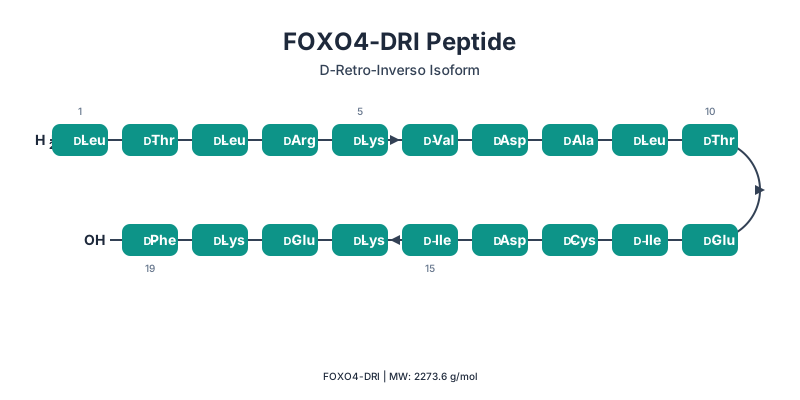
Sequence:
dL-dT-dL-dR-dK-dV-dD-dA-dL-dT-dE-dI-dC-dD-dI-dK-dE-dK-dF Chemical Structure
Research Areas
- Senolytic therapy and targeted apoptosis
- Reversal of age-related frailty
- Chemotherapy-induced cellular toxicity
- Renal function restoration
- Reduction of the senescence-associated secretory phenotype (SASP)
Potential Benefits
- Induces apoptosis strictly in senescent cells
- Reduces systemic inflammation caused by SASP
- Restores physical stamina in aged animal models
- Improves kidney function
- Increases fur density and biological tissue markers
Research Dosing Guidelines
For research purposes only. Not for human consumption.
Typical Dose
1-3 mg
Frequency
Once daily
Duration
3-5 day micro-cycles
Administration
Subcutaneous injection
Senolytics aren't daily drivers. The biohacker community usually pulses this heavily for a few days, then backs off completely for months. You want a sharp, acute spike to trigger apoptosis, not chronic exposure. Let's be real—human data is virtually non-existent, so these protocols are entirely extrapolated from mouse models. For research purposes only.
Reconstitution Calculator
U-100 Insulin Syringe
0.0 units
2500 mcg/ml
0.0004 ml
0.0 IU
5000
For research and educational purposes only. Always follow proper reconstitution and sterile handling protocols.
Senolytic Agents: FOXO4-DRI in the Broader Landscape
FOXO4-DRI is one of several senolytic strategies under investigation. Each approach targets senescent cells through different mechanisms with distinct trade-offs.
Senolytic Comparison
| Agent | Mechanism | Selectivity | Evidence Level |
|---|---|---|---|
| FOXO4-DRI | Disrupts FOXO4-p53 binding | High (senescent cells only) | Animal studies |
| Dasatinib + Quercetin | Tyrosine kinase + flavonoid combo | Moderate | Phase I/II human trials |
| Navitoclax (ABT-263) | Bcl-2 family inhibitor | Moderate (thrombocytopenia risk) | Phase I trials |
| Fisetin | Natural flavonoid senolytic | Low-moderate | Phase II human trials |
FOXO4-DRI offers the highest theoretical selectivity for senescent cells, but its lack of human data puts it behind the dasatinib/quercetin combination in terms of clinical readiness. The D-retro-inverso structure provides excellent protease resistance but makes synthesis expensive.
Potential Side Effects
- Profound fatigue during the clearance phase
- Joint aches and systemic lethargy
- Temporary immune system stress
- Localized injection site pain
Storage Requirements
Store lyophilized powder at -20°C for up to 2 years. Reconstituted solution must be kept strictly at 2-8°C and used within 14 days.
Research References
- [1]Targeted Apoptosis of Senescent Cells Restores Tissue Homeostasis in Response to Chemotoxicity and Aging (2017)Emerging Evidence Population: Fast-aging (XpdTTD/TTD) and naturally aged mice
FOXO4-DRI selectively induced apoptosis in senescent cells and restored fitness, fur density, and renal function in aging mice.
Limitations: Mouse model only; no human safety or pharmacokinetic data
- [2]The Fountain of Youth by targeting senescent cells? (2017)Preclinical Population: Review of preclinical senolytic studies
Outlines the therapeutic mechanism of disrupting the FOXO4-p53 axis to clear senescent cells without harming healthy tissue.
Limitations: Commentary/perspective piece; does not contain new experimental data
- [3]Senolytics in aging and age-related disease (2021)Preclinical Population: Comprehensive review of senolytic compounds in animal models
Evaluates FOXO4-DRI alongside other senolytics for their ability to delay, prevent, or alleviate age-related conditions by removing SASP-secreting cells.
Limitations: No head-to-head comparison between different senolytic agents in matched populations
Frequently Asked Questions
What is FOXO4-DRI?
FOXO4-DRI is a bioengineered senolytic peptide designed to seek out and destroy senescent 'zombie' cells. It uses a mirrored, reversed amino acid structure (D-Retro-Inverso) to completely resist enzymatic breakdown in the body.
What are the potential research benefits of FOXO4-DRI?
Research in animal models shows it can aggressively clear senescent cells, which reduces systemic inflammation caused by the SASP (Senescence-Associated Secretory Phenotype). This targeted clearance has restored physical stamina, kidney function, and fur density in aging mice.
How is FOXO4-DRI typically dosed in research?
Researchers and biohackers use a pulsed approach, typically administering 1-3 mg daily for a short 3-5 day micro-cycle. Because the goal is acute cell clearance, these cycles are only repeated a few times a year.
What are the side effects of FOXO4-DRI?
The clearance of senescent cells triggers a noticeable 'die-off' response in the body. Subjects frequently report profound fatigue, lethargy, and joint aching during the active dosing period.
How should FOXO4-DRI be stored?
Keep the lyophilized powder in the freezer at -20°C. Once reconstituted with bacteriostatic water, store it strictly in the refrigerator at 2-8°C and use it quickly, ideally within two weeks.
Ready to Purchase FOXO4-DRI?
Get the highest quality FOXO4-DRI from our recommended vendor with 99%+ purity guaranteed.
Buy at Simple PeptideRelated Topics
Therapeutic Applications of Peptides
Therapeutic peptides occupy the pharmacological space between small molecules and biologics, offering high selectivity for protein-protein interactions with lower immunogenicity.
Bioactive Peptides and Signaling Pathways
Bioactive peptides regulate physiology through GPCR and receptor tyrosine kinase signaling, functioning as hormones, neurotransmitters, and local mediators.
Safety & Reference
Related Peptides
Epithalon
Epithalon (Epitalon)
Epithalon is a synthetic tetrapeptide based on the natural peptide epithalamin, which is produced by the pineal gland. It has been extensively researched for its ability to activate telomerase and potentially extend lifespan in animal models.
Learn MoreHumanin
Humanin (HN)
Humanin isn't your standard synthetic chain. It's a mitochondrial-derived peptide (MDP) encoded directly in the 16S rRNA gene of your mitochondrial DNA. Japanese researchers stumbled on it in 2001 while analyzing surviving neurons in Alzheimer's brains. The fact that mitochondria pump out their own protective peptides to keep host cells alive under extreme stress is fascinating. Let's be real—the human data is still thin, but the rodent longevity and neuroprotection models are aggressive.
Learn MoreMOTS-C
Mitochondrial Open Reading Frame of the Twelve S rRNA-c
MOTS-c isn't your standard synthetic peptide concocted in a lab. It is a naturally occurring mitochondrial-derived peptide (MDP) discovered by USC researchers in 2015. The wild part is that it's encoded directly in the mitochondrial DNA rather than the cellular nucleus. The scientific community unofficially calls it the 'exercise mimetic' because it forces cells into a state of metabolic stress identical to high-intensity cardiovascular training.
Learn MoreSS-31
Elamipretide (SS-31)
SS-31, clinically known as Elamipretide, forces us to rethink how we handle cellular aging. Discovered by researchers Hazel Szeto and Peter Schiller (hence the 'SS' designation), this tetrapeptide physically localizes to the inner mitochondrial membrane. Most longevity compounds try to boost mitochondrial function indirectly through signaling pathways. SS-31 ignores the middleman and acts as a targeted structural reinforcement exactly where the cell generates energy.
Learn More