
MGF
Mechano Growth Factor (MGF)
Mechano Growth Factor (MGF) is an alternative splice variant of the IGF-1 gene, specifically known as IGF-1Ec in humans. Geoffrey Goldspink's lab nailed this discovery in the late 90s when they realized muscle tissue expresses a unique growth factor in direct response to physical stretch and mechanical overload. Most of what you buy as "MGF" is actually just the 24-amino acid C-terminal sequence of this variant. Base MGF has a half-life of mere minutes, making it trickier to use than its pegylated cousin (PEG-MGF), but purists still prefer this base version for targeted, immediate post-workout applications.
Purity
99%+
Molecular Weight
2867.2 g/mol
Administration
Intramuscular injection directly into the trained muscle group
Storage
Store lyophilized powder at -20°C
Mechanism of Action
When you smash a muscle with heavy resistance, the IGF-1 gene splices to create MGF before shifting to produce standard IGF-1. MGF does something standard IGF-1 cannot do: it activates muscle stem cells, or satellite cells, and forces them to multiply. Standard IGF-1 pushes these cells to differentiate and fuse with muscle fibers, but MGF expands the total pool of available raw materials first. We know MGF works through a distinct, independent receptor from the standard IGF-1 receptor, though researchers are still trying to pin down the exact binding site structure.
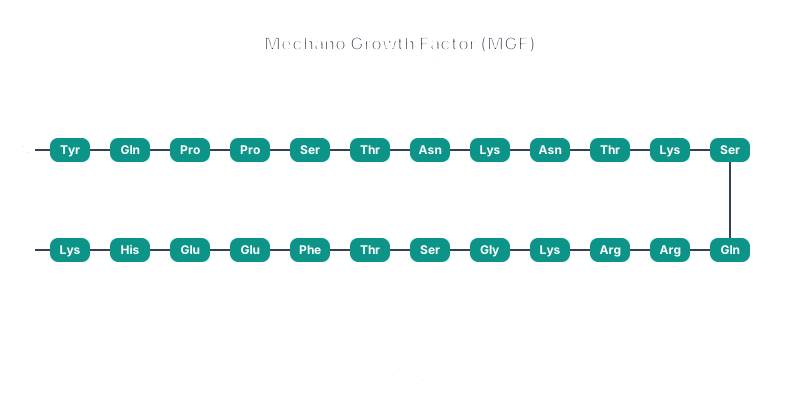
Sequence:
Tyr-Gln-Pro-Pro-Ser-Thr-Asn-Lys-Asn-Thr-Lys-Ser-Gln-Arg-Arg-Lys-Gly-Ser-Thr-Phe-Glu-Glu-His-Lys Chemical Structure
Research Areas
- Satellite cell proliferation
- Myocardial infarction repair
- Age-related sarcopenia
- Neuroprotection in ischemia
- Localized muscle hypertrophy
Potential Benefits
- Expands satellite cell pools in damaged muscle
- Accelerates recovery from mechanical overload
- Promotes localized tissue repair
- Protects cardiac tissue post-injury
- Demonstrates neuroprotective effects in animal models
Research Dosing Guidelines
For research purposes only. Not for human consumption.
Typical Dose
100-200 mcg per side (bilaterally)
Frequency
Only on training days, immediately post-workout
Duration
4-6 weeks
Administration
Intramuscular injection directly into the trained muscle group
Timing is everything with base MGF because the half-life is incredibly short (under 10 minutes). The community standard is pinning it bilaterally into the target muscle group within 30 minutes of your last set. Never run this simultaneously with IGF-1 LR3, as they compete for satellite cell action—use MGF to proliferate, and IGF-1 later to differentiate. For research purposes only.
Reconstitution Calculator
U-100 Insulin Syringe
10.0 units
1000 mcg/ml
0.100 ml
10.0 IU
20
For research and educational purposes only. Always follow proper reconstitution and sterile handling protocols.
Base MGF vs PEG-MGF: Choosing the Right Version
Both versions trigger satellite cell proliferation, but their pharmacokinetics and ideal use cases are fundamentally different.
Version Comparison
| Factor | Base MGF | PEG-MGF |
|---|---|---|
| Half-life | ~5 minutes | Several days |
| Administration | Bilateral IM (into trained muscle) | Subcutaneous (anywhere) |
| Timing | Immediately post-workout | Rest days only |
| Action | Acute, localized pulse | Sustained systemic exposure |
| Mimics natural physiology? | Yes (acute MGF pulse) | No (sustained, non-physiological) |
| Injection pain | Significant (IM) | Mild (SubQ) |
Purists prefer base MGF for its physiological mimicry of the natural post-exercise MGF pulse. PEG-MGF is more practical for researchers who want sustained satellite cell activation without the demanding timing and IM injection requirements.
Potential Side Effects
- Hypoglycemia (mild compared to insulin)
- Severe injection site pain or localized swelling
- Water retention
- Theoretical cancer risk due to cell proliferation pathways
Storage Requirements
Store lyophilized powder at -20°C. Once reconstituted with bacteriostatic water, store at 2-8°C and use within 7-10 days maximum due to rapid degradation.
Research References
- [1]A synthetic mechano growth factor E peptide enhances myogenic precursor cell stretch-induced proliferation (2007)Preclinical Population: C2C12 murine myoblast cell cultures
MGF peptide addition significantly enhanced satellite cell proliferation compared to controls.
Limitations: In-vitro cell line; satellite cell response in human muscle tissue may differ
- [2]Mechanical signals, IGF-I gene splicing, and muscle adaptation (2005)Preclinical Population: Review of rabbit and rodent muscle overload models
Identified the specific splicing switch from MGF to systemic IGF-1 following mechanical overload.
Limitations: Mechanistic review; no standardized exogenous MGF dosing protocols in humans
- [3]Different roles of the IGF-I splice variants, IGF-IEa and IGF-IEc (MGF), in mechanical stretch (2002)Preclinical Population: C2C12 myoblast stretch-injury models
Demonstrated that MGF expression precedes IGF-1Ea and uniquely drives initial stem cell expansion.
Limitations: In-vitro model; in-vivo temporal splicing kinetics may differ
Frequently Asked Questions
What is MGF?
Mechano Growth Factor (MGF) is an alternative splice variant of the IGF-1 gene expressed by muscle tissue in response to mechanical overload. Synthetic MGF typically consists of the unique 24-amino acid C-terminal sequence responsible for its biological activity.
What are the potential research benefits of MGF?
MGF primarily drives the activation and proliferation of muscle satellite cells. By expanding the pool of available stem cells, it sets the stage for enhanced localized muscle hypertrophy and accelerated tissue repair following heavy mechanical stress.
How is MGF typically dosed in research?
Researchers typically administer 100-200 mcg of base MGF bilaterally directly into the trained muscle group. Because of its extremely short half-life, these intramuscular injections are given immediately after a training session to mimic the body's natural release pulse.
What are the side effects of MGF?
The most common side effect is intense injection site pain and localized swelling, especially given the intramuscular administration route. Other risks include mild hypoglycemia, water retention, and theoretical risks involving unwanted cellular proliferation.
How should MGF be stored?
Lyophilized MGF must be stored at -20°C for long-term stability. Once reconstituted, it degrades rapidly and should be kept at 2-8°C and used within 7 to 10 days.
Ready to Purchase MGF?
Get the highest quality MGF from our recommended vendor with 99%+ purity guaranteed.
Buy at Simple PeptideRelated Topics
Biological Roles of Peptides in Humans
Peptides serve as crucial signaling molecules in the human body, functioning as hormones, neurotransmitters, and immunomodulators that regulate virtually every physiological process.
Therapeutic Applications of Peptides
Therapeutic peptides occupy the pharmacological space between small molecules and biologics, offering high selectivity for protein-protein interactions with lower immunogenicity.
Safety & Reference
Related Peptides
BPC-157
Body Protection Compound-157
BPC-157 is a pentadecapeptide composed of 15 amino acids. It is a partial sequence of body protection compound (BPC) that is discovered in and isolated from human gastric juice. Research has shown it accelerates the healing of many different wounds, including tendon-to-bone healing and superior healing of damaged ligaments.
Learn MoreTB-500
Thymosin Beta-4
TB-500 is a synthetic version of the naturally occurring peptide Thymosin Beta-4. It plays a crucial role in tissue repair, regeneration, and protection. TB-500 is known for its ability to promote healing, reduce inflammation, and improve flexibility.
Learn MoreIGF-1 LR3
Insulin-like Growth Factor 1 Long R3
Native IGF-1 is incredible for tissue growth, but its half-life is a pathetic 10 to 20 minutes. Researchers fixed this by adding a 13-amino-acid extension to the N-terminus and swapping glutamic acid for arginine at position 3. The result is IGF-1 LR3, an 83-amino-acid beast that completely evades IGF-binding proteins. You get a half-life of 20 to 30 hours and roughly triple the biological potency of standard IGF-1.
Learn More