
IGF-1 LR3
Insulin-like Growth Factor 1 Long R3
Native IGF-1 is incredible for tissue growth, but its half-life is a pathetic 10 to 20 minutes. Researchers fixed this by adding a 13-amino-acid extension to the N-terminus and swapping glutamic acid for arginine at position 3. The result is IGF-1 LR3, an 83-amino-acid beast that completely evades IGF-binding proteins. You get a half-life of 20 to 30 hours and roughly triple the biological potency of standard IGF-1.
Purity
99%+
Molecular Weight
9111.4 g/mol
Administration
Subcutaneous or bilateral intramuscular
Storage
Store lyophilized powder at -20°C for up to 3 years
Mechanism of Action
IGF-1 LR3 forces its way into the IGF-1 receptor (IGF-1R) without getting trapped by binding proteins circulating in the blood. Once attached, it flips the switch on the PI3K/Akt pathway to drive massive protein synthesis, and the MAPK pathway to trigger cell division. We are talking about actual muscle hyperplasia—splitting and creating brand new muscle cells—not just inflating existing ones. It also shunts amino acids and glucose directly into muscle tissue, partitioning nutrients entirely away from fat stores.
Sequence:
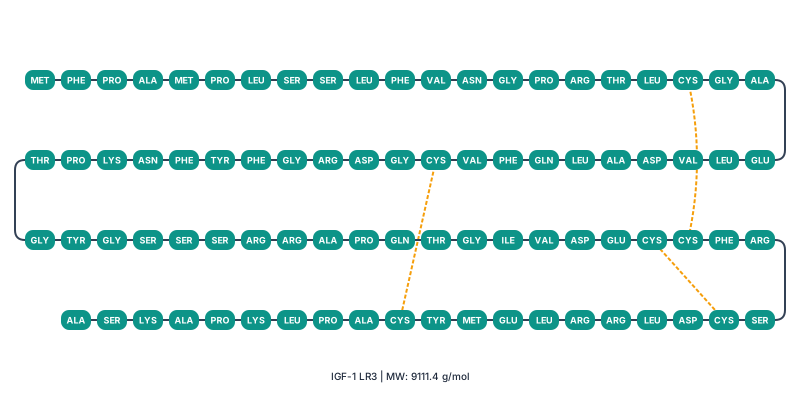
MFPAMPLSSLFVNGPRTLCGAELVDALQFVCGDRGFYFNKPTGYGSSSRRAPQTGIVDECCFRSCDLRRLEMYCAPLKPAKSA Chemical Structure
Research Areas
- Skeletal muscle hyperplasia and hypertrophy
- Cell culture media optimization
- Myostatin regulation and signaling
- Nutrient partitioning and glucose metabolism
- Cartilage and connective tissue regeneration
Potential Benefits
- Induces muscle cell hyperplasia (new cell creation)
- Dramatically increases nitrogen retention
- Drives amino acids directly into muscle tissue
- Improves recovery time between intense bouts of training
- Promotes systemic fat loss via nutrient partitioning
Research Dosing Guidelines
For research purposes only. Not for human consumption.
Typical Dose
20-50 mcg
Frequency
Once daily, typically post-workout or first thing in the morning
Duration
4 weeks (strict maximum)
Administration
Subcutaneous or bilateral intramuscular
The community is obsessed with bilateral IM injections into the trained muscle, but the science shows IGF-1 LR3 goes systemic regardless of where you pin it. Receptor desensitization hits a brick wall at about 4 weeks. If you run it longer, you are just wasting biological pathways and risking insulin resistance. Reconstitute with 0.6% acetic acid, as standard bacteriostatic water degrades LR3.
Reconstitution Calculator
U-100 Insulin Syringe
40.0 units
50 mcg/ml
0.400 ml
40.0 IU
5
For research and educational purposes only. Always follow proper reconstitution and sterile handling protocols.
IGF-1 LR3 vs MGF vs PEG-MGF: Growth Factor Comparison
These three growth factor peptides operate on related but distinct pathways in muscle tissue. Choosing the right one depends on whether the research goal is cell growth, cell multiplication, or both.
Growth Factor Comparison
| Factor | IGF-1 LR3 | MGF (Base) | PEG-MGF |
|---|---|---|---|
| Primary action | Differentiation + hypertrophy | Satellite cell proliferation | Satellite cell proliferation (sustained) |
| Half-life | 20-30 hours | ~5 minutes | Several days |
| Dosing | 20-50 mcg/day | 100-200 mcg post-workout | 200-400 mcg 2-3x/week |
| Administration | SubQ or bilateral IM | Bilateral IM (trained muscle) | SubQ (systemic) |
| Cycle length | 4 weeks maximum | 4-6 weeks | 4-6 weeks |
| Hypoglycemia risk | High | Mild | Low |
The optimal research protocol sequences MGF first (to expand the satellite cell pool) followed by IGF-1 LR3 (to differentiate and mature those new cells). Running them simultaneously creates receptor competition and diminishes the effect of both.
Potential Side Effects
- Hypoglycemia (crashing blood sugar)
- Receptor downregulation after 4 weeks
- Lethargy and extreme training fatigue
- Water retention
- Theoretical acceleration of existing tumor growth
Storage Requirements
Store lyophilized powder at -20°C for up to 3 years. Reconstitute with 0.6% acetic acid and keep at 2-8°C for up to 30 days.
Research References
- [1]Enhanced biological potency of an IGF-1 analogue (Long R3 IGF-I) in skeletal muscle (1996)Emerging Evidence Population: Rat skeletal muscle preparations
The LR3 modification prevents binding to IGFBPs, dramatically increasing the tissue-building potency compared to native IGF-1
Limitations: Animal tissue model; binding protein evasion confirmed but systemic safety not assessed
- [2]IGF-I variants that bind poorly to IGF-binding proteins show enhanced biological activity (1995)Preclinical Population: In-vitro cell proliferation assays
Evading binding proteins allows free IGF-1 analogs to maintain continuous receptor activation
Limitations: Cell culture model; free IGF-1 activity may increase cancer risk in vivo
- [3]Nutrient partitioning effects of Long R3-IGF-1 relative to standard IGF-1 (1999)Emerging Evidence Population: Growing rats with continuous IGF-1 LR3 infusion
Systemic administration alters glucose metabolism, aggressively driving nutrients into muscle rather than adipose tissue
Limitations: Juvenile growth model; adult body composition effects may differ
Frequently Asked Questions
What is IGF-1 LR3?
IGF-1 LR3 is a synthetic, 83-amino-acid analog of human Insulin-like Growth Factor 1. By adding a 13-amino-acid extension and modifying the third amino acid, researchers created a version that ignores IGF-binding proteins. This extends its half-life from 20 minutes to over 24 hours.
What are the potential research benefits of IGF-1 LR3?
The primary draw in research is skeletal muscle hyperplasia, meaning the creation of completely new muscle cells rather than just expanding existing ones. It also aggressively partitions nutrients, driving glucose and amino acids into muscle tissue while mobilizing stored fat.
How is IGF-1 LR3 typically dosed in research?
Research protocols generally cap at 20 to 50 mcg per day, administered subcutaneously or intramuscularly. Cycles are strictly limited to 4 weeks because IGF-1 receptors downregulate rapidly, rendering the compound useless if pushed longer.
What are the side effects of IGF-1 LR3?
Because it heavily impacts glucose metabolism, hypoglycemia is a real and immediate risk if subjects aren't fed properly. Other reported issues include severe lethargy, fluid retention, and the potential acceleration of any pre-existing cellular mutations or tumors.
How should IGF-1 LR3 be stored?
Lyophilized powder goes in the freezer at -20°C. Once reconstituted, it must be stored in the refrigerator at 2-8°C, and frankly, you should be using 0.6% acetic acid for reconstitution because bacteriostatic water degrades LR3 very quickly.
Ready to Purchase IGF-1 LR3?
Get the highest quality IGF-1 LR3 from our recommended vendor with 99%+ purity guaranteed.
Buy at Simple PeptideRelated Topics
Peptide Hormones and Their Functions
Peptide hormones are hydrophilic signaling molecules that bind cell surface receptors, triggering intracellular cascades via second messengers like cAMP and calcium.
Bioactive Peptides and Signaling Pathways
Bioactive peptides regulate physiology through GPCR and receptor tyrosine kinase signaling, functioning as hormones, neurotransmitters, and local mediators.
Safety & Reference
Related Peptides
CJC-1295
CJC-1295 (with or without DAC)
CJC-1295 is a synthetic 29-amino-acid analog of growth hormone-releasing hormone (GHRH), originally developed by ConjuChem Biotechnologies. It stimulates the pituitary gland to release growth hormone in a dose-dependent manner. It comes in two forms: with DAC (Drug Affinity Complex), which uses a maleimidopropionic acid linker to bind the peptide to serum albumin and extend its half-life to roughly 8 days, and without DAC (also called Mod GRF 1-29), which has a half-life of about 30 minutes and produces sharper, more natural GH pulses.
Learn MoreIpamorelin
Ipamorelin Acetate
Ipamorelin is a selective growth hormone secretagogue and ghrelin receptor agonist. It is known for producing a clean growth hormone release without significantly affecting cortisol or prolactin levels, making it one of the safest GH-releasing peptides.
Learn MoreTesamorelin
Tesamorelin Acetate
Tesamorelin is a synthetic form of growth hormone-releasing hormone (GHRH). It is FDA-approved for reducing excess abdominal fat in HIV patients with lipodystrophy. It has become of interest for its ability to reduce visceral adipose tissue.
Learn MoreMGF
Mechano Growth Factor (MGF)
Mechano Growth Factor (MGF) is an alternative splice variant of the IGF-1 gene, specifically known as IGF-1Ec in humans. Geoffrey Goldspink's lab nailed this discovery in the late 90s when they realized muscle tissue expresses a unique growth factor in direct response to physical stretch and mechanical overload. Most of what you buy as "MGF" is actually just the 24-amino acid C-terminal sequence of this variant. Base MGF has a half-life of mere minutes, making it trickier to use than its pegylated cousin (PEG-MGF), but purists still prefer this base version for targeted, immediate post-workout applications.
Learn More