5-Amino-1MQ
5-Amino-1-Methylquinolinium
Let's clear something up right away: 5-Amino-1MQ isn't actually a peptide. It's a membrane-permeable small molecule that gets lumped into the peptide conversation because of how researchers and biohackers use it. Discovered by researchers at the University of Texas, it's a highly selective NNMT inhibitor that flips the metabolic switch in fat cells. Instead of acting like a crude central nervous system stimulant, it directly targets cellular energy machinery to shrink white adipose tissue.
Purity
99%+
Molecular Weight
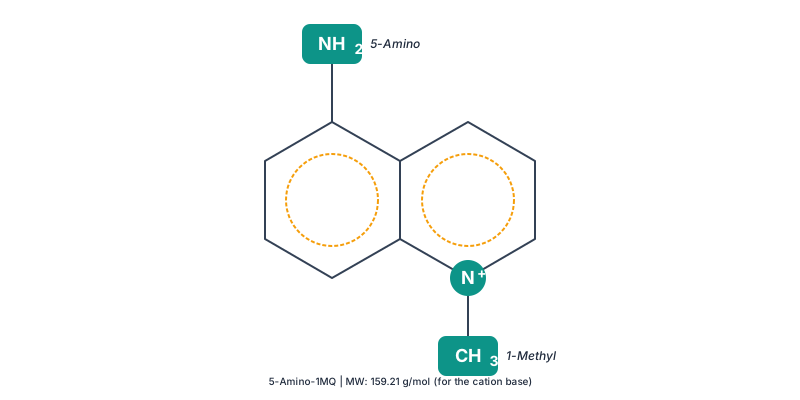
159.21 g/mol (for the cation base)
Administration
Oral (capsule)
Storage
Store at room temperature in a cool, dry place away from direct sunlight
Mechanism of Action
The process relies on blocking an enzyme called Nicotinamide N-methyltransferase (NNMT). When you inhibit NNMT, you stop the body from dumping nicotinamide, which forces a massive downstream increase in cellular NAD+ levels. This surge in NAD+ cranks up SIRT1 activity and basal metabolic rate, causing fat cells to essentially shrink while sparing muscle tissue. You get the metabolic engine revving at the cellular level without touching heart rate or blood pressure.
Sequence:
C10H11N2+ (Small molecule chemical structure, not an amino acid sequence)
Chemical Structure
Interactive 3D
Loading 3D structure...
2D Structure Reference
Research Areas
- NNMT inhibition and obesity
- Cellular NAD+ salvage pathways
- White adipose tissue reduction
- Age-related muscle atrophy (sarcopenia)
- Metabolic syndrome in diet-induced models
Potential Benefits
- Targeted reduction in white adipose tissue
- Significant increases in cellular NAD+ levels
- Elevated basal metabolic rate without CNS stimulation
- Prevention of diet-induced obesity
- Protection against age-related muscle wasting
Research Dosing Guidelines
For research purposes only. Not for human consumption.
Typical Dose
50-150 mg
Frequency
1-3 times daily (usually capped at 150mg total per day)
Duration
4-8 weeks
Administration
Oral (capsule)
Because it boosts ATP and cellular energy via NAD+, you want to take your last dose by early afternoon to avoid wrecking your sleep. The community almost exclusively runs this orally, often stacked with MOTS-c or Tesamorelin for aggressive fat loss protocols. Let's be real—the published efficacy data is entirely murine (mice) right now, so human dosing is completely extrapolated from those animal models.
Reconstitution Calculator
U-100 Insulin Syringe
0.2 units
25000 mcg/ml
0.0020 ml
0.2 IU
1000
For research and educational purposes only. Always follow proper reconstitution and sterile handling protocols.
NNMT Inhibition: The Metabolic Mechanism Explained
5-Amino-1MQ's mechanism revolves entirely around blocking a single enzyme — NNMT — that sits at a critical metabolic crossroads. Understanding this pathway explains why the compound affects fat, energy, and muscle simultaneously.
NNMT Inhibition Cascade
| Step | What Happens | Downstream Effect |
|---|---|---|
| 1. NNMT blocked | Nicotinamide is no longer methylated and wasted | NAD+ salvage pathway stays active |
| 2. NAD+ levels rise | Cellular energy currency accumulates | SIRT1 activation increases |
| 3. SIRT1 activated | Master metabolic regulator switches on | Fat oxidation increases, inflammation decreases |
| 4. SAM conserved | S-adenosylmethionine is not consumed by NNMT | Improved methylation capacity systemwide |
| 5. Fat cells shrink | White adipose tissue metabolic rate increases | Reduced body fat without CNS stimulation |
Unlike stimulant-based fat loss compounds, 5-Amino-1MQ does not raise heart rate or blood pressure. The metabolic acceleration occurs entirely at the cellular enzyme level, making it a fundamentally different approach to body composition research.
Potential Side Effects
- Difficulty sleeping if taken late in the day
- Mild gastrointestinal distress
- Restlessness from sudden cellular energy increases
Storage Requirements
Store at room temperature in a cool, dry place away from direct sunlight. Unlike most peptides, oral capsules do not require refrigeration.
Research References
- [1]Selective and membrane-permeable small molecule inhibitors of nicotinamide N-methyltransferase reverse diet-induced obesity in mice (Biochemical Pharmacology, 2018) (2018)Emerging Evidence Population: Diet-induced obese C57BL/6J mice
5-Amino-1MQ reduced body weight and white adipose tissue mass by 30% in diet-induced obese mice without affecting food intake.
Limitations: Mouse model only; no human pharmacokinetic data available
- [2]Small molecule nicotinamide N-methyltransferase inhibitor activates senescent muscle stem cells and improves regenerative capacity of aged skeletal muscle (Biochemical Pharmacology, 2018) (2018)Emerging Evidence Population: Aged C57BL/6J mice with sarcopenia
Inhibiting NNMT with 5-Amino-1MQ restored NAD+ levels and improved muscle regeneration in aged mice.
Limitations: Animal model; human muscle stem cell response may differ
- [3]Nicotinamide N-methyltransferase: A Promising Target for Therapeutics (Trends in Pharmacological Sciences, 2019) (2019)Preclinical Population: Review of preclinical NNMT inhibitor studies
NNMT is established as a critical metabolic checkpoint, directly linking its overexpression to obesity and type 2 diabetes.
Limitations: Therapeutic review; no direct efficacy data for 5-Amino-1MQ in humans
Frequently Asked Questions
What is 5-Amino-1MQ?
5-Amino-1MQ is a membrane-permeable small molecule, often categorized with peptides due to its use in the biohacking community. It functions as a highly selective inhibitor of the NNMT enzyme, which regulates metabolism and cellular energy.
What are the potential research benefits of 5-Amino-1MQ?
Animal studies show it aggressively reduces white adipose tissue, increases basal metabolic rate, and elevates cellular NAD+ levels. Researchers also observed that it protects against age-related muscle wasting by activating senescent muscle stem cells.
How is 5-Amino-1MQ typically dosed in research?
Research subjects generally receive 50 to 150 mg of 5-Amino-1MQ daily via oral capsules. Protocols usually split the dose across the morning and early afternoon over a 4 to 8-week period.
What are the side effects of 5-Amino-1MQ?
Because it acts largely on cellular energy pathways rather than the central nervous system, adverse effects are minimal. The most common issues are insomnia if taken too late in the day and occasional mild gastrointestinal upset.
How should 5-Amino-1MQ be stored?
It is stable at room temperature. Keep it in a cool, dry environment away from direct light, with no refrigeration required.
Ready to Purchase 5-Amino-1MQ?
Get the highest quality 5-Amino-1MQ from our recommended vendor with 99%+ purity guaranteed.
Buy at Simple PeptideRelated Topics
Therapeutic Applications of Peptides
Therapeutic peptides occupy the pharmacological space between small molecules and biologics, offering high selectivity for protein-protein interactions with lower immunogenicity.
Peptidomimetics and Peptide Engineering
Peptidomimetics are designed molecules that mimic peptide structure and function while overcoming pharmacokinetic limitations like proteolysis and poor absorption.
Safety & Reference
Related Peptides
AOD-9604
Advanced Obesity Drug 9604
AOD-9604 is a modified fragment of human growth hormone (HGH) specifically designed to have the fat-reducing effects of HGH without the negative side effects on blood sugar or growth. It corresponds to the C-terminal portion of HGH.
Learn MoreTesamorelin
Tesamorelin Acetate
Tesamorelin is a synthetic form of growth hormone-releasing hormone (GHRH). It is FDA-approved for reducing excess abdominal fat in HIV patients with lipodystrophy. It has become of interest for its ability to reduce visceral adipose tissue.
Learn MoreMOTS-C
Mitochondrial Open Reading Frame of the Twelve S rRNA-c
MOTS-c isn't your standard synthetic peptide concocted in a lab. It is a naturally occurring mitochondrial-derived peptide (MDP) discovered by USC researchers in 2015. The wild part is that it's encoded directly in the mitochondrial DNA rather than the cellular nucleus. The scientific community unofficially calls it the 'exercise mimetic' because it forces cells into a state of metabolic stress identical to high-intensity cardiovascular training.
Learn MoreSS-31
Elamipretide (SS-31)
SS-31, clinically known as Elamipretide, forces us to rethink how we handle cellular aging. Discovered by researchers Hazel Szeto and Peter Schiller (hence the 'SS' designation), this tetrapeptide physically localizes to the inner mitochondrial membrane. Most longevity compounds try to boost mitochondrial function indirectly through signaling pathways. SS-31 ignores the middleman and acts as a targeted structural reinforcement exactly where the cell generates energy.
Learn More