Kisspeptin-10
Kisspeptin-10 (Metastin 45-54)
Originally discovered in Hershey, Pennsylvania (which earned it the "Kiss" moniker), Kisspeptin-10 is the biologically active 10-amino acid fragment of the KISS1 protein. While researchers initially classified it as a tumor suppressor called metastin, athletes use it for one very specific reason. It sits at the absolute top of the hypothalamic-pituitary-gonadal (HPG) axis as the master switch for endogenous testosterone production.
Purity
99%+
Molecular Weight
1302.4 g/mol
Administration
Subcutaneous injection
Storage
Store lyophilized powder at -20°C for up to 2 years
Mechanism of Action
Kisspeptin-10 binds directly to the GPR54 receptor in the hypothalamus. Flipping this switch triggers a massive, pulsatile release of Gonadotropin-Releasing Hormone (GnRH). GnRH then commands the pituitary gland to release Luteinizing Hormone (LH) and Follicle-Stimulating Hormone (FSH) into the bloodstream. Unlike exogenous androgens that suppress your natural factory, Kisspeptin forces your body to manufacture its own testosterone from scratch.
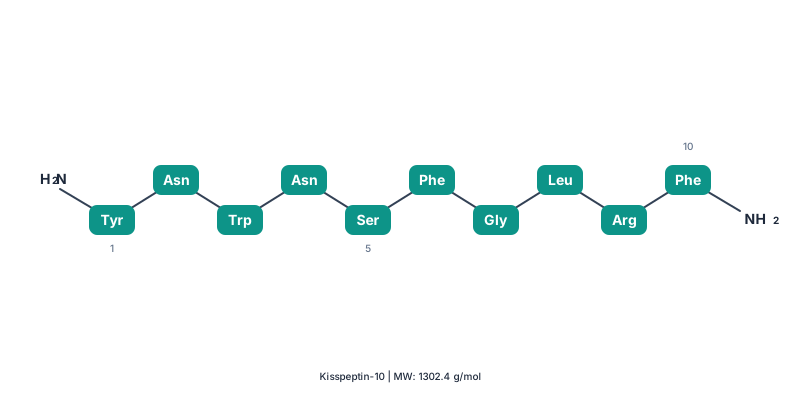
Sequence:
Tyr-Asn-Trp-Asn-Ser-Phe-Gly-Leu-Arg-Phe-NH2 Chemical Structure
Research Areas
- HPTA axis recovery and stimulation
- Hypogonadism and testosterone deficiency
- LH pulse frequency modulation
- Psychological aspects of libido and sexual behavior
- Spermatogenesis and fertility markers
Potential Benefits
- Direct stimulation of LH and FSH release
- Increased endogenous testosterone production
- Prevention of testicular atrophy during chemical suppression
- Enhanced libido through direct limbic system pathways
- Faster recovery of natural hormone production post-cycle
Research Dosing Guidelines
For research purposes only. Not for human consumption.
Typical Dose
100-300 mcg
Frequency
1-3 times per week (pulsed)
Duration
4-6 weeks
Administration
Subcutaneous injection
The half-life of Kisspeptin-10 is incredibly short—literally minutes. We treat this as a precision tool to trigger an LH pulse, not a steady-state hormone. Do not pin this daily. Continuous receptor exposure causes rapid desensitization and will completely crash your LH production, defeating the entire purpose of HPTA stimulation.
Reconstitution Calculator
U-100 Insulin Syringe
4.0 units
2500 mcg/ml
0.040 ml
4.0 IU
50
For research and educational purposes only. Always follow proper reconstitution and sterile handling protocols.
HPTA Stimulation: Kisspeptin-10 vs Gonadorelin vs hCG
All three peptides are used to stimulate testosterone production, but they act at different points in the hypothalamic-pituitary-gonadal axis with fundamentally different mechanisms.
HPTA Stimulation Comparison
| Factor | Kisspeptin-10 | Gonadorelin (GnRH) | hCG |
|---|---|---|---|
| Acts on | Hypothalamus (GPR54) | Pituitary (GnRH-R) | Testes (LH receptor) |
| Stimulates | GnRH release → LH + FSH | LH + FSH directly | Testosterone directly |
| Pulsatile dosing needed? | Yes (critical) | Yes (critical) | No |
| Desensitization risk | High if overdosed | High if overdosed | Low-moderate |
| Spermatogenesis | Supported (via FSH) | Supported (via FSH) | Limited (no FSH) |
| Half-life | Minutes | 2-4 minutes | 24-36 hours |
Kisspeptin-10 activates the entire HPG cascade from the top, providing the most physiological stimulation. hCG bypasses the hypothalamus and pituitary entirely, making it the most convenient but least physiological option.
Potential Side Effects
- Transient flushing or sweating immediately after injection
- Severe receptor down-regulation if overdosed
- Changes in emotional processing or mood
- Mild injection site irritation
Storage Requirements
Store lyophilized powder at -20°C for up to 2 years. Once reconstituted with bacteriostatic water, refrigerate at 2-8°C and use within 14-21 days due to its rapid degradation profile.
Research References
- [1]Kisspeptin-10 is a potent stimulator of LH and increases pulse frequency in men (2011)Strong Evidence Population: Healthy adult males (n=6)
A single intravenous injection of Kisspeptin-10 powerfully stimulated LH secretion and temporarily increased LH pulse frequency in healthy male subjects.
Limitations: Very small sample; single IV bolus dose only
- [2]Kisspeptin modulates sexual and emotional brain processing in humans (2017)Strong Evidence Population: Healthy heterosexual men (n=29)
Administration of kisspeptin acutely enhanced brain activity in limbic regions associated with sexual arousal and reward processing.
Limitations: fMRI surrogate endpoint; behavioral outcomes not assessed
- [3]Continuous infusion of kisspeptin-10 desensitizes the kisspeptin receptor in men (2014)Strong Evidence Population: Healthy adult males (n=8)
Continuous exposure to Kisspeptin-10 resulted in a rapid decline in testosterone and LH, proving that pulsatile dosing is absolutely required for HPTA stimulation.
Limitations: Small sample; IV infusion protocol does not reflect typical SubQ research use
Frequently Asked Questions
What is Kisspeptin-10?
Kisspeptin-10 is a 10-amino acid neuropeptide that acts as the primary upstream regulator of human reproduction. It binds to receptors in the hypothalamus to trigger the cascade of hormones that ultimately results in testosterone production.
What are the potential research benefits of Kisspeptin-10?
Researchers primarily study Kisspeptin-10 for its ability to stimulate Luteinizing Hormone (LH) and Follicle-Stimulating Hormone (FSH) release. This makes it a powerful tool for investigating endogenous testosterone recovery, reversing testicular atrophy, and enhancing libido.
How is Kisspeptin-10 typically dosed in research?
Standard research protocols use 100-300 mcg administered via subcutaneous injection. Because continuous exposure downregulates the receptor, it is explicitly pulsed 1 to 3 times per week rather than injected daily.
What are the side effects of Kisspeptin-10?
The most significant risk is chemical castration (crashing LH and testosterone) if administered too frequently. Acute side effects are usually mild and include temporary flushing, sweating, or injection site irritation.
How should Kisspeptin-10 be stored?
Keep the lyophilized powder in the freezer at -20°C. Once reconstituted, store it in the refrigerator at 2-8°C and use it within 3 weeks to prevent degradation.
Ready to Purchase Kisspeptin-10?
Get the highest quality Kisspeptin-10 from our recommended vendor with 99%+ purity guaranteed.
Buy at Simple PeptideRelated Topics
Peptide Hormones and Their Functions
Peptide hormones are hydrophilic signaling molecules that bind cell surface receptors, triggering intracellular cascades via second messengers like cAMP and calcium.
Neuropeptides vs. Peptide Hormones
Cells build both neuropeptides and peptide hormones through shared biosynthetic pathways. That common origin is where the similarity ends. The two classes split at the point of release. Neuropeptides act through neural signaling, reaching targets near the neurons that produce them. Peptide hormones follow endocrine signaling instead, traveling to distant sites in the body. Release location, target range, and signaling mode create the practical split between two peptide classes that otherwise share a biological starting point.
Safety & Reference
Related Peptides
CJC-1295
CJC-1295 (with or without DAC)
CJC-1295 is a synthetic 29-amino-acid analog of growth hormone-releasing hormone (GHRH), originally developed by ConjuChem Biotechnologies. It stimulates the pituitary gland to release growth hormone in a dose-dependent manner. It comes in two forms: with DAC (Drug Affinity Complex), which uses a maleimidopropionic acid linker to bind the peptide to serum albumin and extend its half-life to roughly 8 days, and without DAC (also called Mod GRF 1-29), which has a half-life of about 30 minutes and produces sharper, more natural GH pulses.
Learn MorePT-141
Bremelanotide (PT-141)
PT-141, also known as Bremelanotide, is a synthetic peptide analog of alpha-melanocyte stimulating hormone. It was initially developed for tanning effects but showed significant effects on sexual function through direct CNS pathways rather than vascular mechanisms.
Learn MoreMelanotan II
Melanotan II
Melanotan II is a synthetic analog of alpha-melanocyte stimulating hormone. It was originally developed to promote tanning without UV exposure. Research has shown effects on skin pigmentation, appetite, and sexual function.
Learn More